Tuesday, December 8, 2009

How accurate are college rankings?

How accurate are college rankings?
Wed, Dec 09, 2009
China Daily/Asia News Network

For Jia Zhenmei, choosing the right university for her 18-year-old daughter next summer is a critical decision - but pinning her hopes on China's college rankings could be a big mistake, according to experts.

This could be a life-changing decision, so I can't afford to get it wrong," said the 42-year-old mother. "We don't know much about universities, we just want to get as much information as we can so I will definitely be buying some books to find out the university rankings."

She is not alone. Parents across China, as well as overseas students will feverishly check the national rankings to help them decide which institution to put their faith in.

Marcus Nelson Muhariwa, 29, had never heard of Tsinghua University before reading an online ads in his native Malawi for its global business journalism program two years ago.

"I inquired about the school online and learned from Chinese people in Malawi that it was rated top in China," he said. "After I found out about its world ranking, I was even more confident."

Tsinghua's top position may not be questionable. But education experts have questioned the effectiveness and objectiveness of the listings published by unofficial organizations on the Internet and in books in China.

Meanwhile, the Ministry of Education's stance is very clear. "We don't support university rankings," said its spokeswoman Xu Mei in May.

Corruption during university evaluation has been reported in the Chinese media, while it is also alleged independent organizations make inspections of selected universities before official assessments in order to give them "top marks".

Rankings are now a worldwide phenomenon, said Professor Tom Parker, a senior associate at the Institute for Higher Education Policy in Washington, in the United States.

Those published by the London-based Times Higher Education supplement and the world rankings compiled at the Shanghai Jiao Tong University have become key points of reference for anyone interested in education.

For Ferdinand Devinsky, member of the Poland-based International Observatory on Academic Ranking and Excellence, a university ranking system allows "society to not only know what it will get for its investment, but what the future will be for its children".

"Equally, higher education institutions should use their ranking to improve," he said. "It must be stated, though, that all rankings are subjective and the results depend on the criteria used."

But to work, the professor said the systems must be free of corruption.

"When a proper ranking is made, there should be no contact with the institution, the leadership of the university or the higher education institution," he said. "Only publicly available data can be used so everyone can check the accuracy of the data and the results. This limits any possibility of corruption."

Chinese experts argue higher education evaluation is better than rankings.

"I prefer higher education evaluations," said Professor Liu Baocun, dean of the international and comparative education research institute at Beijing Normal University.

"This way, rather than ranking universities and giving them a score, we can identify the advantages and disadvantages of a university and determine the direction of further development."

Liu believes universities should not be compared with each other using fixed criteria. He said distinctions exist such as how much emphasis is placed on research and teaching or whether the university specializes in science or art degrees.

"University rankings will be more accurate if they are assessed by category," added Liu, who warned the public not to blindly follow university rankings. "Students should check the ranking of a major rather than the ranking of a university. Even great universities can have weak majors."

Yang Deguang, former president at Shanghai Normal University, was also quoted by China Youth Daily as saying that parents and students should not depend entirely on rankings when applying for college.

Yang called for universities to focus on their own advantages and traditions. "A universities' development should be based on its specialties. They cannot be distracted by rankings," he was quoted as saying.


To tell if a girl fancies you, watch her feet

To tell if a girl fancies you, watch her feet

Wed, Dec 09, 2009
The Straits Times

LONDON - Eye contact and body language have long been considered tell-tale signs of cheating, nervousness, sexual attraction and lying.

Now, a British psychologist says he has found a new body language in which humans use their feet to give out signals, The Telegraph reported.

'While people might know what their facial expression or hands might be imparting, they will often have no idea whether their feet are moving or the messages their feet are sending out,' said Professor Geoffrey Beattie, head of school and dean of psychological sciences at the University of Manchester.

Compiling research on behalf of shoemakers Jeffery West, Prof Beattie found that women often signal attraction with their feet. If a woman fancies someone and is laughing, her feet will move away from her body and she will have an open leg posture. If her feet are crossed or tucked away under her body, then she is not attracted to the other party.

Men, on the other hand, do not signal sexual attraction with their feet. For them, it is more head tilting.

Liars keep their feet unnaturally still, to try and distract people away from their fibbing.

If a man is nervous, he will show his feelings by increasing his foot movement. Women do the opposite and keep their feet still if they are nervous.

Alpha males and females have a low level of leg and foot movement because they like to dominate and control the conversation and the same goes for their body.

Extroverts do likewise but for different reasons, while shy people have frequent movements. Arrogant people also keep their bodies more in check and use less foot movement.

'The secret language of feet can reveal a great deal about our personality, what we think of the person we're talking to and even our emotional and psychological state. They are a fascinating channel of non-verbal communication,' said Prof Beattie, resident psychologist on popular TV show Big Brother.

'The reason our feet may be giving us away is that they are part of the body from which we have the least internal feedback.'

This article was first published in The Straits Times.

4 things never to do when it comes to sex

4 things never to do when it comes to sex
Tue, Dec 08, 2009
AsiaOne

While it may seem like anything can go during sex, some rules are meant to be followed if you want a healthy sex life, says Fox News Sexpert Yvonne Fulbright.

Dr Fulbright, the author of the book, Sex with Your Ex & 69 Other Things You Should Never Do Again... Plus a Few That You Should, lists several rules never to break during sex. Here are four of them.


1. Never drink more than 1-2 glasses of alcohol

Photo: ST, Desmond Wee

Drinking too much might cause erectile difficulties and vaginal dryness in women. When you're too drunk and lose control of your senses, you are also putting yourself at risk of participating in high-risk sexual activities which you might regret later.

Although a little bit of alcohol might boost your self-confidence, it is best not to overdo things.

2. Never douche before sex

Photo: TNP, Audrey Tan

Douching - the process of cleaning the vagina by forcing water or another solution into its cavity - is not healthy, says Dr Fulbright. Doing so causes the vagina's delicate chemical imbalance to tilt and may put you at risk of developing pelvic inflammatory disease or other health problems. It is better to let the vagina clean itself, she says.

3. Don't attempt strange positions if inflexible

Photo: ST, Alan Lim

There is no need to be an acrobat to enjoy good sex, she says. You are putting yourself at risk of twisting your back if you attempt hard-to-do positions. Stick to doing the deed in positions that are comfortable for you.

4. Never compare yourself to air-brushed models

Photo: ST, Alan Lim

Don't use Victoria's Secret models as the standard to judge your looks or body, says Dr Fulbright. "You've got your own unique look and that can be super sexy, depending on how you wear it," she says, adding that looking good starts with a confident smile.

Monday, December 7, 2009

The Great Tanah Melayu Debate

The Great Tanah Melayu Debate
Archive 2009
2 Dec 2009

We hear UMNO's cries for “Brain Gain”, caused by excruciating “Brain Drain”, in the wake of hundreds of thousands of Malaysians who are fleeing their country. We've heard the many alleged reasons provided from both sides of the fence. One of the strongest seems to be the fact that UMNO is asking all “pendatangs” to leave the country if they are not happy.

By Michael Chick

Well, Robert Kwok certainly did just that. And along with him, his entire businesses worth billions in “Tax Drain”. BTN has also been copiously assisting, by enthusiastically brainwashing simple minds into thinking that “Tanah Melayu” is reserved for Orang Melayu. Of course, they quickly tell you that anyone can become an Orang Melayu by speaking, dressing, and behaving like one (whatever that means, who knows?).

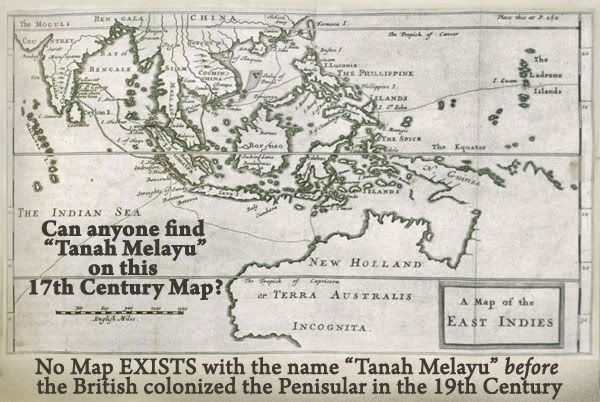
Well, UMNO managed to achieve one thing. The BTN-type morons, and their predecessors, have been overwhelmingly successful in brainwashing todays' 27 million citizens. Who says that the Peninsular was ALWAYS called “Tanah Melayu”? This is a recent British Term!! Let me dedicate this Article to the foremost “so-called reknown Historian” of the country. Prof Dr Emeritus Khoo Khay Khim (and anyone else who claims to be as competent in History as well).

Prior to “Tanah Melayu” being a British Tag in the 19th century, the peninsular was formerly known as Malacca in the 15th century. The newly-renamed book “Sejarah Melayu” (previously known as “Asal-Usul Raja-Raja”) mentions every other place from India to China, including the tiny-speck-of-dirt called Temasik EXCEPT “Tanah Melayu”. Why was Tanah Melayu NEVER MENTIONED in Sejarah Melayu? Simple!! Because that was not its name!!

Tanah Melayu was NEVER the name until the British came and colonized the Peninsular.

(please see map below)

Since UMNO has a habit of believing that “whatever is older is better”, let's take a short walk down this slippery slope of history. (Also, BTN-Baru syllabus planners should start taking notes.)

For starters, “Malaya” in Tagalog means “Peaceful” (go ask your Pinoy maid).

Malai” means “Hill” in Tamil; as in “mini-Himalaya” to describe the Titiwangsa Range on the said Peninsular since the 2nd century by the Gujerati Traders who helped the local Malays set up their formidable Hindu Empire at Lembah Bujang.
ref: Prof Nik Hassan, Tom Harrison, and H.G Quatrich Wales

Also read here: http://www.astigan.com/2009/03/06/ppag-unearths-evidence-of-iron-industry-in-lembah-bujang/

Only in the 19th Century was The Peninsular known as “Tanah Melayu”.

In the 15th Century, the Peninsular was known by no other name than “The Malacca Peninsular”.

Before “that Rebel-Indonesian Guy” came over here (look, he wanted to kill his own father; what else do you want me to call Parameswara?), the Peninsular was known as “Barr Kra” in the 10th Century. Before that, the Peninsular was known as the “Golden Chersonese” since the 2nd Century.

“Golden Chersonese is the ancient name to refer to the Malay Peninsula by Claudius Ptolemy or Claudius Ptolemaeus (Greek: Κλαύδιος Πτολεμαῖος; c. 90 – c. 168). Known in English as Ptolemy, he was a Greek-speaking geographer, astronomer, and astrologer. During Roman times, the Malay Peninsula developed an international reputation as a source of gold; hence the name was given.”

By the way, “Barr” simply means “Land” in the Persian Language. And Barr Kra above, means “Land of Kra” (as in reference to the Isthmus of Kra).

But I've saved the best for last, as usual. And I hope all you soon-to-be “Brain Gain” people are sitting down reading this ....

The earliest known Arabic Maps refer to the Peninsular as “Barr CHIN”.

Where Chin refers to CHINA! Why did the Arabs call this Peninsular “Tanah China” instead of “Tanah Melayu”? When Prophet Muhammad s.a.w. spoke about “Exotic Tanah China”, was he actually refering to Malaya? After all, according to records, Malayan Gold Mines was already famous 500 years BEFORE the Prophet was born!! As his wife, Khadijah was a Great Trader. He must have known!

Footnote: Chin is spelt “Xin” by the Portuguese, but always pronounced as Chin.

Alright, it's now public!! The oldest known Arab Maps called the Peninsular “Barr Chin”; which translates to “Tanah China”, or “Land of Chinese”. BTN can now implement this new found knowledge into their syllabus. You cannot deny that you don't know it now! Perhaps if you spoke Hokkien, dressed like a Hokkien, and practised Hokkien Customs, the Hokkiens might be gracious enough to accept you. Sounds absurd? Absolutely; and so does the other “Great Race-Changing Trick” practised by UMNO. And I quote Prof Dr Anthony Milner (ANU), “If it's so easy to join a race, it must be equally easy to 'un-join' that race ...

Alright, Prof Khoo, your turn now ...

This will be the first exercise in “Brain Gain” which UMNO is allegedly proposing, for the greater good of 1Malaysia; plus, I'll even give you a hint: (because I'm nice and assume that you actually really, really, really, don't know ....)

It's a Dark Green Hardcover Book about an inch thick; usually reserved for Academicians like yourself. So you won't find it in Popular, MPH, Wiki, Amazon or any Pasar Malam. I'm sure that Great Historians like yourself, have your own Jstor Account number.

Unfortunately, it's written in English, so UMNO people cannot possibly understand it; because, as they say it so eloquently, “...that English sounds like strange babbling ....” So be nice, Prof, and please translate it for them. And in my best Manglish, “Can translate or not? Please?”

Me? I'll take a nice stroll over to the Royal Netherlands Institute of Southeast Asian and Caribbean Studies here in Leiden, to read more on this .... I'd better put on a Jacket too, it's a little nippy today.

Doei!!” Pronounced, 'do-we' in Dutch.

tanahmelayumap

Replace the BTN

Replace the BTN, which spent RM550 million in past ten years to incite racial hatred and animosity to create more racists than Malaysian nationalists, with an independent non-partisan institution answerable only to Parliament

Biro Tata Negara (BTN) spent RM550 million in the past ten years from 2000 to 2009 to incite racial hatred and animosity to create more racists than Malaysian nationalists and was a major push factor for the brain drain driving Malaysia’s best and brightest from Malaysian shores in the past decade.

The annual budget for the BTN in the past ten years, totalling RM548 million, is as follows:

Year Expenditure
(RM)
2000 28,928,500
2001 27,172,300
2002 34,199,700
2003 35,620,163
2004 86,165,889
2005 68,160,330
2006 43,097,076
2007 74,339,400
2008 76,348,700
2009 74,023,100


For next year of 2010, RM62.5 million has been budgeted for BTN.

These are huge sums of money. How can there be justification for the expenditure by such vast sums of money for an agency to continue its anti-national agenda to divide Malaysians with its divisive, racist and seditious indoctrination programmes, as further testified by student council representatives from several public universities yesterday.

University of Malaya Students Council president, Mohd Ridzuan Mohammad, described the BTN course as “unsuitable” as it “incites racial sentiments and does not help provide better representation to the student body”.

University Kebangsaan Malaysia (UKM), student council member Hisyamuddin Che Ali said Faculty of Islamic Studies complained that racial sentiments were fanned at BTN courses…for example, they were told that the Chinese are lording over the country.

The RM550 million spent by the government on BTN have undermined nation building and national unity, resulting in the nation losing greater international competitiveness as it is a major push factor in driving the best and brightest Malaysians out of the country – contributing to Malaysia’s lagging in economic development to neighbouring countries in the past decade.

If the Prime Minister, Datuk Seri Najib Razak is serious about national reforms to “recatalyse” the country with the 1Malaysia concept, he should have no hesitation in closing down the BTN with its racist and anti-national agenda and replace it with n independent non-partisan national civics institution which is completely independent of the government-of-the-day and answerable to Parliament for its curriculum and management to foster national unity and Malaysian consciousness.

Dr M a ‘bloody racist,’ says Nazri

Dr M a ‘bloody racist,’ says Nazri

7 Dec 2009

(Free Malaysia Today) - A cabinet minister has called former prime minister Tun Dr Mahathir Mohamad a “bloody racist” and chided the Umno-owned newspaper Utusan Malaysia for its “denial sydrome.”

The outburst came from Minister in the Prime Minister’s Department Datuk Seri Nazri Aziz, according to the online newspaper Malaysian Insider.

Nazri was criticising Dr Mahathir for defending Biro Tata Negara (BTN) courses.

He reasserted the Cabinet’s decision to overhaul the BTN programme, saying there was nothing to hide because “everybody knows what the BTN is.”

Of Utusan Malaysia, he said its “denial syndrome” was making him laugh.

http://freemalaysiatoday.com/english/?p=3492

Who is frivolous: PI Bala or PM Najib?

Who is frivolous: PI Bala or PM Najib?
7 Dec 2009

If Najib is a responsible Prime Minister, he should have felt duty bound under his oath of allegiance to the country to clear his name through a proper inquiry by an independent and reputable panel, now that the perception of his involvement has been so entrenched and pervasive nationally as well as internationally.

By Kim Quek

When questioned by reporters regarding private investigation P Subramaniam’s latest revelations implicating the family of Prime Minister Najib Razak in the Altantuya murder scandal, Najib snapped “I will not entertain any frivolous statement” and asked reporters to move on to the next question.

This curt reply to crassly cut reporters off from asking further questions sounds to me more like a reflex in panic, rather than a responsible answer from the prime minister of a supposedly democratic country. For it was a totally inappropriate reply to Bala’s serious accusation, made in circumstances that commanded respect and credibility.

What can be more serious than accusing Najib’s wife Rosmah Mansor and his brother Nazim of having used the “carrot and stick” meneuver to force Bala to retract his first affidavit which implicated Najib in the murder scandal?

And what can be more respectable than having his revelations made in an interview conducted and witnessed by three senior lawyers of the country?

Bala alleged that Rosmah’s close associate Deepak Jaikishan offered him RM5 million and Nazim threatened to harm his family unless he followed Deepak’s instructions. This happened on the day he disclosed his first affidavit on 4th July 2008. Fearing the safety of his family, Bala retracted under coercion the allegations linking Najib to Altantuya in a second affidavit the next day, and disappeared immediately with his family until his recent interview which was captured in video and recorded in transcripts. These were first published in Malaysia-today.net and later relayed by other websites including Malaysiakini and Youtube.

In the interview, Bala described how he was forced into retraction and how he and his family embarked on their fugitive journey to India under the overall direction of Deepak. That journey was a rather convoluted and lengthy voyage that saw them passing through or staying for various durations at Singapore, Bangkok, Katmandu, Delhi, Madras and eventually Chennai.

Bala exuded confidence with his detailed description of occurrences supported by factual details that pin point the relevant players, locations, times, dates, durations, hotels, monetary figures, cheques, bank accounts, etc.

Against these formidable allegations, all we have from the alleged culprits is deafening silence, despite the news being circulated in the Internet for more than two weeks. Until, of course, when Najib dismissed these as “frivolous” and not worthy of his response, during a press conference after an UMNO supreme council meeting on Dec 4. This effectively means that Bala has cooked up a pack of damned lies, according to Najib.

So, one of them must have lied. Was it Bala, or was it Najib?

FACTS FAVOUR BALA

A cursory glance at the facts and circumstances surrounding the latest controversy would enable one to readily conclude that Bala has the upper hand, for the simple reasons that Bala’s accusation is buttressed by precise facts and details that could be easily debunked if false, while Najib and his group have chosen to remain silent in spite of the serious nature of the accusation.

If Bala’s statement is false, and with the immense power and resources at the disposal of the Prime Minister, there is no possible reason for Najib not to have instantly ordered an investigation, and bring Bala to face the consequences for having so openly and repeatedly defamed the Prime Minister and his family.

If Najib could have Raja Petra Kamarudin - webmaster of Malaysia Today - charged for criminal defamation for the publication of an article in his website that said Rosmah was present at the crime scene, why can’t he do the same on Bala?

In fact, Bala’s case is even more serious, as he has signed two contradictory affidavits – a clear offence of false declaration – besides accusing the Prime Minister and his family of involvement in murder.

And why should the Prime Minister, his family, and the various law-enforcement agencies be so kind and forgiving to Bala as to leave him untouched, while the nation suffers the humiliation of its Prime Minister being openly defamed and ridiculed?

FROM ANOTHER PERSPECTIVE

Viewing the case from another angle – Bala’s perspective, it appears even more compelling that Bala was not likely to have lied.

Why should a family man like Bala falsely accuse the Prime Minister of involvement in the most heinous of crimes, knowing its serious consequences as an ex-police officer? What possible gain could he get, keeping in mind that he couldn’t have extorted any money, since the allegation is untrue?

Even if it is true that Bala had falsely accused Najib, that he had repented and retracted his allegations in a second affidavit, and ran away to another country to escape retribution, there is no conceivable reason for him to make a come-back to invent another pack of lies, thereby exposing himself for the second time to the risk of serious punishment. Unless, of course, he is a lunatic, which is clearly not the case.

GROUNDS OF SUSPICION ABOUND

Evidence of justice being aborted to protect Najib is found in the numerous irregularities that had occurred before and during the trial of the Altantuya murder.

Why was Najib not investigated since the first two accused, who were his body guards and took orders from him, had no apparent motive on their own to commit the murder, and the third accused was his confidante?

Why were the judge, prosecutors and even a defence lawyer abruptly replaced without credible reasons shortly before the trial?

Why was the motive for murder never raised during the trial?

Why did prosecutors and defence lawyer join forces to prevent critical evidence being pursued in court such as a certain photograph showing Altantuya and Najib taking meals together and the mysterious erasure of immigration entry records of Altantuya and her Mongolian companions?

Why was Bala’s affidavit barred from the court without credible reasons?

Since the third accused, who was charged for instigating the murder, was released without his defence being called, then who had ordered the killing?

It is clear that unless these troubling questions are dealt with satisfactorily, there is no way Najib can clear himself of suspicions that have surrounded him, least of all by waving away inquisitive questions by a curt reply like what he did in the said press conference.

In fact, such conduct only betrays his weaknesses. For it is plain commonsense that if Najib is on the side of truth, he would have welcomed reporters to ask questions – instead of crudely shutting them up – so that he has a chance to exonerate himself. And he would also have taken action against Bala ages ago, instead of inaction for so long – perhaps with the hope of the scandal fizzling out in due course?

The latest Bala revelations have constituted a solemn challenge to the integrity and legitimacy of Najib’s premiership, for which he must now solemnly account to the nation.

And the only way to do that without dishonoring his oath of office is to commission a truly independent panel to uncover the truth and account to the nation.

How many more lives? Kit Siang asks outgoing MACC chief

How many more lives? Kit Siang asks outgoing MACC chief

Written by Chua Sue-Ann, The Edge

DAP veteran Lim Kit Siang today blasted outgoing Malaysian Anti-Corruption Commission (MACC) Chief Commissioner Datuk Seri Ahmad Said Hamdan for dismissing the death of political secretary Teoh Beng Hock as "a very small case".

Lim took Ahmad Said to task over the latter's recent statements denying that political pressure or negative public perception sparked by the controversial death of Teoh had caused the MACC chief to opt for an early retirement.

Ahmad Said was quoted by The Star as saying on Sunday: "Teoh Beng Hock’s case is nothing. It is a very small case. We have handled much bigger cases".

"How can the head of an independent and professional anti-corruption agency dismiss Teoh’s mysterious and shocking death as 'a very small case' and of no consequence?"

"How many lives must be lost in MACC precincts before they become major issues?" Lim said in a statement today.

Teoh's death had sparked intense public uproar after the 30-year-old was found dead on July 16 on a fifth-floor landing of the Plaza Masalam in Shah Alam, next to an office block that houses Selangor MACC.

The aide to Selangor state executive council member Ean Yong Hian Wah had been held overnight at the state MACC for questioning into anti-corruption investigations on allegations of misappropriation of funds by several Pakatan Rakyat assemblymen.

The Ipoh Timur member of parliament also slammed Ahmad Said's remarks as "heartless and grossly insensitive" but pointed out that the latest comments were exceeded only by Ahmad Said's earlier "distasteful" statements implying Teoh had taken his own life.

Shortly after Teoh's death, Ahmad Said was quoted as saying, "If people investigated could not withstand the pressure and jumped from the building, there was nothing that MACC could do".

Lim demanded Ahmad Said to explain Malaysia's declining ranking and scores in the Transparency International (TI) Corruption Perception Index (CPI) 2009 report and whether Teoh's "mysterious" death had contributed to a loss of confidence in MACC.

Lim also questioned whether MACC deputy commissioner Datuk Abu Kassim Mohamed, who is slated to take over as MACC chief on Jan 1, would dissociate himself from Ahmad Said's "outrageous" statements and attitude that "there is no difference between corruption involving a few ringgit and corruption involving a few hundred millions of ringgit".

Also read:

“Teoh Beng Hock’s case is nothing. It is a very small case.” – Ahmad Said’s guilty mind speaking