Showing posts with label Education. Show all posts

Tuesday, January 19, 2010

Top student a Malaysian, again?

Top student a Malaysian, again?

Jan 18, 2010
Sin Chew Daily

When the Singapore-Cambridge General Certificate of Education (Ordinary Level) Examination results were released last year, the country's leading Chinese-language newspaper Lianhe Zaobao used the headline: Top O-Level student again a Malaysian?.

I was attracted by the word "again".

Her name is Lai Kai Rou and same as top student last year Haw Sue Hern, she studied in S.R.J.K (C) Lick Hung before going to study in Singapore.

Photo: Sin Chew Daily

The report stressed that in S.R.J.K (C) Lick Hung, everything is taught in Chinese except for English subject. I would like to add that S.R.J.K (C) Lick Hung is a Chinese primary school.

Lai, who has again won glory for the country, is one of the 17 foreign students among the 43 top O-Level scorers.

I must mention here that among the above-mentioned 17 foreign students, 11 of them are from China and six of them are Malaysians. The number is equal to 40% of the 43 top scorers.

Singaporeans exclaimed in surprise. They wondered why there were so many foreigners among the top scorers.

At the same time, we also exclaimed in surprise. We wondered why so many top students have gone to Singapore.

Singaporeans were wondering why the top O-Level student was not a Singaporean and why Singaporean students were lack of spirit compared to foreign students.

Meanwhile, we were wondering why we always lose talents.

Lai said: "I like the freedom given by the peaceful Singapore, it allows me to move around without worry."

In fact, leaving home is no longer about the pain of "homesick" but the freedom without fear!

Of course, a little girl's way of thinking is relatively simple. For her parents (both graduates of the University of Malaya), studying in Singapore allows her to enjoy other freedoms. For example, the freedom of choosing a university, the freedom of choosing a major and the freedom of getting a scholarship based on academic results without the so-called quota system and colour distinction.

How many Malaysian students, like Lai and her younger brother, have been flocking to further their studies in Singapore right after they have completed their primary schools with the scholarship provided by Singapore every year?

And how many Malaysian students from Chinese independent high schools (second-class students and copycats for Singapore Minister Mentor Lee Kuan Yew and historian and academician Prof Emeritus Tan Sri Khoo Kay Kim) have been enrolled into prestigious universities of the Lion City every year and end up settling down while contributing to the prosperity of the country?

There are many shining stars who are originated from Malaysia in Singapore. For example, founder, Group Chief Executive Officer, and President of the Singapore-based Hyflux Group Olivia Lum used to be an orphan from Perak; and Chief Executive Officer of Jetstar Asia Chong Phit Lian was just a little girl selling pineapples at her own doorstep in Kulai, Johor when she was six.

The current Health Minister of Singapore Khaw Boon Wan is also originated from Malaysia. He used to study in the Penang Chung Ling High School.

In fact, there are too many similar stories to tell.

Thursday, January 7, 2010

What Singaporeans read

What Singaporeans read
Jan 04, 2010
The Straits Times

By magdalen ng

Singaporeans love their chick lit and horror. The proof lies in the most borrowed books lists from the network of public libraries in Singapore.

Over the National Library Board's financial year 2008, from April last year to March this year, the bulk of the top 10 most checked out titles in Young People English fiction list were written by chick lit authors.

Chick lit refers to fiction written for and targeted at young women.

The Adult fiction list had a little more variety, but bestselling chick lit stalwarts such as Sandra Brown, Sophie Kinsella, Amanda Quick and Nora Roberts took up nearly half the list.

Horror stories, particularly Singapore ghost stories, are also hot with borrowers, accounting for all but one of the top 10 books borrowed from the Adult English titles in the Singapore Collection during that period. To make it into the lists, each book has to be borrowed between 347 and 4,410 times over the time period.

Singaporeans, it seems, seek escapism in their reading material.

National University of Singapore's sociology professor Alexius Pereira says: 'The fiction list probably signals that readers are after entertainment rather than intellectualisation.'

He adds: 'We would expect that people gravitate towards 'fun' books rather than heavy works of fiction.'

His observation is borne out by what some borrowers at the National Library told Life!. Ms Clarissa Chang, a 23-year-old editor for assessment books, borrrows mainly chick lit books whenever she visits the library.

'Life is hard enough, so I would rather let loose and read books that are nobrainers,' she says, naming author Jennifer Crusie as one of her favourites.

Pharmacy assistant Nana Raihanah, 21, is addicted to horror for the same reason: 'Ghost stories are much more exciting and fun to read, so I usually borrow these books.'

Another trend evident from the most borrowed lists is the impact of popular culture, especially in the form of movies, on Singaporeans' borrowing patterns.

Over a period of three financial years from April 2007 to November this year, books which have been turned into films were popular choices with borrowers.

Hence, the presence of titles such as Khaled Hosseini's The Kite Runner, a tale of friendship between two boys growing up in Afghanistan before the Soviet invasion, which was turned into a movie in 2007, and Sue Kidd Monk's The Secret Life Of Bees, the tale of a young girl and her friendship with her nanny in 1960s America whose movie adaptation starred Dakota Fanning and Queen Latifah.

Ms Heng Huey Bin, a librarian with the National Library Board, says that movies 'bring alive the storyline'.

She adds: 'The original novels gain popularity as people watch the movie and are interested to find out more about the characters and further immerse themselves in it or the sequels.'

For housewife Fanny Mak, whether a book has been adapted for a movie is a gauge of how well written the book is.

The 32-year-old takes her two children to the library at least twice a month but she does not have much time to read or to slowly choose the books she wants to borrow.

She says: 'If the book has been made into a movie, it should be quite decent. So far, I haven't been disappointed.'

She has read Girl With A Pearl Earring by Tracy Chevalier, which was made into a movie in 2003, starring Colin Firth and Scarlett Johansson, as well as J.R.R. Tolkien's Lord Of The Rings series.

She adds: 'But these books are usually hot property and sometimes I have to go a few times before I finally get to borrow them.'

Just as Ms Mak relies on movie adaptations as a yardstick, borrowers at the library depend on recommendations from various sources. So the popularity of a book spikes when it is recommended by the media or the National Library Board.

Mark Haddon's The Curious Incident Of The Dog In The Night-Time took top spot in the Young People English fiction list, and The Alchemist by Paulo Coelho was second on the Adult English fiction list. Both titles were recommended for nationwide reading during the Read! Singapore Campaign 2007.

The annual reading campaign is organised by the board to promote reading. And borrowing of these titles increases during the three-month-long campaign because all the libraries will display the 16 recommended titles prominently in four languages.

Recommendations are a fast and easy way to get to the best books.

Student Songma Jin Yang, 16, usually relies on endorsements from friends or magazines to pick out books at the library.

'I will browse through the other books in the library only when I can't find the books that I want in the system,' she says.

The National Library Board buys about 50 copies of each book and for more popular titles, they can buy up to 180 copies.

'The number of reservations and popularity of previous works by the same author or in the same series gives us some indication of the anticipated popularity,' says Ms Heng.

But whatever it is that Singaporeans are borrowing, they are continuing to borrow from the library.

The total number of English book loans has been consistent for FY2007 to FY2008. In the last financial year, there were 8.2 million loans of the 1.84 million English books in the board's lending collection.

Retiree James Tan says: 'I have so much time on my hands and I read at least one book every week.'

The 56-year-old adds: 'If I had to buy all of them, I'd be penniless. The libraries are my best friends.'

Why poly grads are more 'marketable'

Why poly grads are more 'marketable'
Fri, Jan 08, 2010
The Straits Times

By Serene Luo

WHILE university graduates are wallowing in self-pity over the latest news that more of them are unemployed than are polytechnic graduates, the latter group is laughing all the way to the bank.

The Manpower Ministry recently found that more than 20 per cent of the unemployed in Singapore were university graduates, while just 6 per cent were polytechnic graduates.

One common reason offered was that polytechnic graduates command a lower starting pay of between $1,600 and $1,800 a month, compared with a university graduate's $2,000 or more a month.

During a downturn, perhaps the difference in dollars makes sense.

But I say it's also because employers, who can pick and choose at this time, are valuing attitude over aptitude - and this has turned the tables on students who think that attaining a university degree is the end of having to work hard.

It's a common perception here, drummed into students' heads since young, that university graduates have the best brains, and this gives some of them airs and expectations.

But not all the top brains are going the junior college-university route. Some students with top O-level results have chosen the polytechnic route, recognising it as a hands-on, skills-based way to university.

The present-day diploma holders - the product of the past five years or so of the polytechnics' improved curricula, programmes and image - may be just as brainy as degree holders, but without the airs.

Without the expectation that a degree brings with it better pay, polytechnic graduates are more willing to work their way up, and are not so arrogant as to expect their own office with a window view from Day One.

Many of them have also held part-time jobs during their relatively longer summer holidays, doing anything from selling ice-cream to folding clothes and putting on shoes for customers as sales assistants in department stores.

Fewer junior college students, who generally have much shorter school holidays, have taken up such jobs - or even thought about doing such menial tasks, which some may feel are beneath their educational level.

So if polytechnic graduates are just as smart as university graduates, are willing to accept lower pay and have the attitude to match, why shouldn't employers value this segment of GenY?

I'm not thumbing my nose at university graduates but, guys, we should really look at the name we're giving ourselves.

I graduated from a Singapore university almost five years ago when the economy was still recovering from the Sars fallout. Many graduates that year spent months supposedly job-hunting, but more of them were taking month-long 'graduation trips' back to back.

When they finally landed jobs, many didn't stick with them once the economy picked up. They left as soon as positions with greater prestige, or which offered a few dollars more, came along - precisely what employers are now worried about again.

So eat humble pie, university graduates, because you can't have your cake and eat it too.

This article was first published in The Straits Times.

Tuesday, January 5, 2010

'Ma, I made it to a US college'

'Ma, I made it to a US college'

Jan 04, 2010
New Straits Times

By Nurjehan Mohamed

THE trick to being accepted into an American university can be summed up in one word: preparation.

"In a way, you should start preparing as soon as you enter secondary school," says Jay Getz, a volunteer with the Malaysian-American Commission on Educational Exchange (MACEE).

He recently spoke to parents and students at MACEE about how to put together a solid application for United States universities in conjunction with the organisation and the US Embassy's International Education Week.

Aside from your grade point average (GPA), university admissions officers would also be looking at standardised test scores (such as the SAT or ACT tests) as well as your commitment to extracurricular activities and your essay.

The essay, he adds, is the chance for you to sell yourself and to show admissions officers what you can offer the university.

"It's similar to applying for a job because you're trying to put your best foot forward," he says.

This is not the time to boast about your achievements but neither should you be too modest about what you have done.

The essay, Getz adds, is what would differentiate you from thousands of other applicants who are relatively equal to you academically.

The essay would reveal who you are as a person -- your background, how your life experience will inform your education and the benefit you would bring to the community at the university.

Some common mistakes that applicants make while writing their essays are that they are vague; they philosophise about topics they are not passionate about and which they haven't thought through; and they fail to give concrete examples of how they have developed as people.

Getz recommends that students start planning for the application process while they are still in secondary school.

"They should be committing themselves to extracurricular activities at school or community service outside of it; and they need to start as soon as they can.

"The later students start, the more difficult it is for them to show the kind of commitment universities are looking for," he adds.

But these activities shouldn't be something that students just tick off in a box; they would need to show that they are passionate about what they do as well as exhibit leadership qualities.

Aside from the basic academic requirements, universities generally look for leaders and people who are dedicated to the subjects that they want to study.

"If you do something you are passionate about, it would be easier to continue doing it and communicating about it."

Basic tips for writing the essays include being clear, concrete and concise and to choose your topics carefully.

"Be consistent with the activities listed in your application.

"Choose an activity you did well and avoid writing about adversities you have yet to overcome," says Getz.

Avoid writing about religion and political adversity as well as common topics such as global warming or how Barack Obama's election was important to you.

Getz also advises against putting anything on your blog or Facebook account that you wouldn't want an admissions officer to see.

"They have the technology to go ahead and look at it if they want to," he says.

While some universities give preference to local high achievers, international students sometimes have an advantage over American students trying to get into college.

The number of Malaysian students enrolled in US institutions of higher education has increased from 5,428 to 5,942 in the 2007/08 academic year, according to Open Doors 2009, the annual report on international student mobility.

The total number of international students in US colleges and universities has increased by eight per cent to an all-time high of 671,616 in the 2008/09 academic year.

"Many universities want their students and faculty to have a diverse experience with people from different cultures and backgrounds.

"International students, by that definition, bring that needed variety to a campus."

How to get accepted into US varsities

How to get accepted into US varsities

Jan 05, 2010
New Straits Times

By Nurjehan Mohamed

THE trick to being accepted into an American university can be summed up in one word: preparation.

"In a way, you should start preparing as soon as you enter secondary school," says Jay Getz, a volunteer with the Malaysian-American Commission on Educational Exchange (MACEE).

He recently spoke to parents and students at MACEE about how to put together a solid application for United States universities in conjunction with the organisation and the US Embassy's International Education Week.

Aside from your grade point average (GPA), university admissions officers would also be looking at standardised test scores (such as the SAT or ACT tests) as well as your commitment to extracurricular activities and your essay.

The essay, he adds, is the chance for you to sell yourself and to show admissions officers what you can offer the university...

Do's and don'ts when writing your essay:

Do be clear, concrete and concise.

Some common mistakes that applicants make while writing their essays are that they are vague; they philosophise about topics they are not passionate about and which they haven't thought through; and they fail to give concrete examples of how they have developed as people.

Do try to keep your essay positive.

Avoid writing about religion and political adversity as well as common topics such as global warming or how Barack Obama's election was important to you.

Do use your best writing skills and edit your essays.

Do let other good English speakers check your work.

Do write about something you're passionate about and that shows your best side.

Aside from the basic academic requirements, universities generally look for leaders and people who are dedicated to the subjects that they want to study.

"If you do something you are passionate about, it would be easier to continue doing it and communicating about it."

Don't use your personal essay to show how modest you are.

The essay is a chance for you to sell yourself and to show admissions officers what you can offer the university.

"It's similar to applying for a job because you're trying to put your best foot forward," he says.

This is not the time to boast about your achievements but neither should you be too modest about what you have done.

Don't share a struggle you had unless you've overcome it.

"Choose an activity you did well and avoid writing about adversities you have yet to overcome," says Getz.

Don't try humour in writing because it rarely translates well across cultures and on paper.


Don't be negative about other races or religions.

Tuesday, December 22, 2009

MOE releases performance by ethnic group

MOE releases performance by ethnic group
Dec 22, 2009
AsiaOne

The Ministry of Education (MOE) released data today on the academic performance of Singapore's major ethnic groups over the past 10 years.

In its statement, MOE stated that its objective is to provide feedback to the communities on how their children fared in the national examinations.

Performance remains consistently high overall, with an overall percentage pass rate of above 95 for the Primary School Leaving Examinations (PSLE).

Secondary school students had at least 3 O level passes also remained close to 95 per cent, and the proportion of GCE A level students who obtained at least 3 H2 passes and passed General Paper or Knowledge and Inquiry continued to be above 85 per cent.

However, as highlighted by Muslim Affairs Minister Yaacob Ibrahim earlier this month, there is a wider discrepancy in performance in Mathematics, with Malay students performing slightly worse.

The percentage of Chinese students and Indian students who scored 'A*' to 'C's in the PSLE have remained fairly constant over the years, with the former hovering at about 90 per cent and the latter at about 72 per cent.

However, the same cannot be said for Malay students, of whom 63.4 per cent scored 'A*' to 'C' in 1999 but only 56.3 per cent did last year.

While, Malay students continue to outperform other ethnic groups in mother tongue scores, their weaker Mathematics and Science results meant that they performed worse overall.

Percentage of PSLE Students Who Scored A*-C in Mathematics

  • Percentages exclude EM3 students.
  • The first batch of students under the adjustment of the promotion criteria from P5 to P6 sat
    for PSLE in 2001.

The percentage of a primary one cohort admitted to post-secondary institutions* has continued to rise, and is now above 90 per cent compared to 78 per cent in 1999.

*These include junior colleges, Centralised Institute, polytechnics, ITE, LASALLE College of the Arts, Nanyang Academy of Fine Arts (NAFA) and other private educational organisations.

Percentage of P1 Cohort Admitted to Post-Secondary Institutions

  • Junior colleges, Centralised Institute, polytechnics, ITE, LASALLE College of the Arts, Nanyang Academy of Fine Arts and other private educational organisations offering courses
    at post-secondary level.
  • Figures for 2004-2008 are preliminary.
  • Figures from 2000 include participation in LASALLE College of the Arts, Nanyang Academy
    of Fine Arts and other private educational organisations, and also take into account students
    who left the country.

Tuesday, December 8, 2009

How accurate are college rankings?

How accurate are college rankings?
Wed, Dec 09, 2009
China Daily/Asia News Network

For Jia Zhenmei, choosing the right university for her 18-year-old daughter next summer is a critical decision - but pinning her hopes on China's college rankings could be a big mistake, according to experts.

This could be a life-changing decision, so I can't afford to get it wrong," said the 42-year-old mother. "We don't know much about universities, we just want to get as much information as we can so I will definitely be buying some books to find out the university rankings."

She is not alone. Parents across China, as well as overseas students will feverishly check the national rankings to help them decide which institution to put their faith in.

Marcus Nelson Muhariwa, 29, had never heard of Tsinghua University before reading an online ads in his native Malawi for its global business journalism program two years ago.

"I inquired about the school online and learned from Chinese people in Malawi that it was rated top in China," he said. "After I found out about its world ranking, I was even more confident."

Tsinghua's top position may not be questionable. But education experts have questioned the effectiveness and objectiveness of the listings published by unofficial organizations on the Internet and in books in China.

Meanwhile, the Ministry of Education's stance is very clear. "We don't support university rankings," said its spokeswoman Xu Mei in May.

Corruption during university evaluation has been reported in the Chinese media, while it is also alleged independent organizations make inspections of selected universities before official assessments in order to give them "top marks".

Rankings are now a worldwide phenomenon, said Professor Tom Parker, a senior associate at the Institute for Higher Education Policy in Washington, in the United States.

Those published by the London-based Times Higher Education supplement and the world rankings compiled at the Shanghai Jiao Tong University have become key points of reference for anyone interested in education.

For Ferdinand Devinsky, member of the Poland-based International Observatory on Academic Ranking and Excellence, a university ranking system allows "society to not only know what it will get for its investment, but what the future will be for its children".

"Equally, higher education institutions should use their ranking to improve," he said. "It must be stated, though, that all rankings are subjective and the results depend on the criteria used."

But to work, the professor said the systems must be free of corruption.

"When a proper ranking is made, there should be no contact with the institution, the leadership of the university or the higher education institution," he said. "Only publicly available data can be used so everyone can check the accuracy of the data and the results. This limits any possibility of corruption."

Chinese experts argue higher education evaluation is better than rankings.

"I prefer higher education evaluations," said Professor Liu Baocun, dean of the international and comparative education research institute at Beijing Normal University.

"This way, rather than ranking universities and giving them a score, we can identify the advantages and disadvantages of a university and determine the direction of further development."

Liu believes universities should not be compared with each other using fixed criteria. He said distinctions exist such as how much emphasis is placed on research and teaching or whether the university specializes in science or art degrees.

"University rankings will be more accurate if they are assessed by category," added Liu, who warned the public not to blindly follow university rankings. "Students should check the ranking of a major rather than the ranking of a university. Even great universities can have weak majors."

Yang Deguang, former president at Shanghai Normal University, was also quoted by China Youth Daily as saying that parents and students should not depend entirely on rankings when applying for college.

Yang called for universities to focus on their own advantages and traditions. "A universities' development should be based on its specialties. They cannot be distracted by rankings," he was quoted as saying.


To tell if a girl fancies you, watch her feet

To tell if a girl fancies you, watch her feet

Wed, Dec 09, 2009
The Straits Times

LONDON - Eye contact and body language have long been considered tell-tale signs of cheating, nervousness, sexual attraction and lying.

Now, a British psychologist says he has found a new body language in which humans use their feet to give out signals, The Telegraph reported.

'While people might know what their facial expression or hands might be imparting, they will often have no idea whether their feet are moving or the messages their feet are sending out,' said Professor Geoffrey Beattie, head of school and dean of psychological sciences at the University of Manchester.

Compiling research on behalf of shoemakers Jeffery West, Prof Beattie found that women often signal attraction with their feet. If a woman fancies someone and is laughing, her feet will move away from her body and she will have an open leg posture. If her feet are crossed or tucked away under her body, then she is not attracted to the other party.

Men, on the other hand, do not signal sexual attraction with their feet. For them, it is more head tilting.

Liars keep their feet unnaturally still, to try and distract people away from their fibbing.

If a man is nervous, he will show his feelings by increasing his foot movement. Women do the opposite and keep their feet still if they are nervous.

Alpha males and females have a low level of leg and foot movement because they like to dominate and control the conversation and the same goes for their body.

Extroverts do likewise but for different reasons, while shy people have frequent movements. Arrogant people also keep their bodies more in check and use less foot movement.

'The secret language of feet can reveal a great deal about our personality, what we think of the person we're talking to and even our emotional and psychological state. They are a fascinating channel of non-verbal communication,' said Prof Beattie, resident psychologist on popular TV show Big Brother.

'The reason our feet may be giving us away is that they are part of the body from which we have the least internal feedback.'

This article was first published in The Straits Times.

4 things never to do when it comes to sex

4 things never to do when it comes to sex
Tue, Dec 08, 2009
AsiaOne

While it may seem like anything can go during sex, some rules are meant to be followed if you want a healthy sex life, says Fox News Sexpert Yvonne Fulbright.

Dr Fulbright, the author of the book, Sex with Your Ex & 69 Other Things You Should Never Do Again... Plus a Few That You Should, lists several rules never to break during sex. Here are four of them.


1. Never drink more than 1-2 glasses of alcohol

Photo: ST, Desmond Wee

Drinking too much might cause erectile difficulties and vaginal dryness in women. When you're too drunk and lose control of your senses, you are also putting yourself at risk of participating in high-risk sexual activities which you might regret later.

Although a little bit of alcohol might boost your self-confidence, it is best not to overdo things.

2. Never douche before sex

Photo: TNP, Audrey Tan

Douching - the process of cleaning the vagina by forcing water or another solution into its cavity - is not healthy, says Dr Fulbright. Doing so causes the vagina's delicate chemical imbalance to tilt and may put you at risk of developing pelvic inflammatory disease or other health problems. It is better to let the vagina clean itself, she says.

3. Don't attempt strange positions if inflexible

Photo: ST, Alan Lim

There is no need to be an acrobat to enjoy good sex, she says. You are putting yourself at risk of twisting your back if you attempt hard-to-do positions. Stick to doing the deed in positions that are comfortable for you.

4. Never compare yourself to air-brushed models

Photo: ST, Alan Lim

Don't use Victoria's Secret models as the standard to judge your looks or body, says Dr Fulbright. "You've got your own unique look and that can be super sexy, depending on how you wear it," she says, adding that looking good starts with a confident smile.

Thursday, November 5, 2009

Bilingual policy was most difficult: MM

Bilingual policy was most difficult: MM
Fri, Nov 06, 2009
The Straits Times

By Jeremy Au Yong

INTELLIGENCE does not necessarily translate into a flair for languages.

That was the lesson Minister Mentor Lee Kuan Yew said he learnt in implementing the bilingual policy in schools.

'Initially, I believed that intelligence was equated to language ability. Later, I found that they are two different attributes - IQ and a facility for languages. My daughter, a neurologist, confirmed this,' he said in an interview carried in Petir, the People's Action Party magazine.

Asked to pick policies he would have implemented differently, he cited the teaching of bilingualism, especially in English and Mandarin, as the most difficult policy.

'I did not know how difficult it was for a child from an English-speaking home to learn Mandarin,' he said.

'If you are speaking English at home and you are taught Mandarin in Primary 1 by Chinese teachers who teach Mandarin as it was taught in the former Chinese schools, by the direct method, using only Mandarin, you will soon lose interest because you do not understand what the teacher is saying.

'You spend time on extra tuition, and still make little progress. Many were turned off Mandarin for life.'

In the end, the Government recognised that students with the same ability in other subjects may not be able to cope being in the same second language class. It took 30 years for the issue to be resolved.

'Eventually, we settled the problem in 2004 by teaching the mother tongue in the module system. Had we done this earlier, we would have had less wastage of students' time and effort, and less heartache for parents,' he said candidly.

While acknowledging the initial approach to the policy was unsatisfactory, he pointed to other policies that were spot on.

Asked about factors which had an impact on the PAP's success, he pointed to winning people's trust, and foresight: 'One attribute with the most lasting impact has been our approach of tackling problems early.'

He cited the Area Licensing Scheme as an example. The 1975 scheme was the precursor to the Electronic Road Pricing scheme and charged motorists for driving into parts of the Central Business District.

'The Area Licensing System, we implemented before cars became so numerous that it became politically difficult. Many big cities in the West are trapped and cannot do this,' Mr Lee said.

Petir also carried comments from Prime Minister Lee Hsien Loong and Senior Minister Goh Chok Tong in its latest issue. Released yesterday, the edition also marks the PAP's 50 years in power.

PM Lee took the opportunity to look ahead and reflect on the future for the PAP and Singapore.

The party must aim to be fresh and relevant, and its policies, organisation and activities must constantly evolve to keep up with the times.

He said: 'The PAP carries a special responsibility for Singapore. The party needs to be there on issues which matter to Singaporeans - bread-and-butter issues like jobs, education, health care and housing, as well as softer issues such as the environment, the arts and rejuvenating our city.'

SM Goh commented on the policy he was most proud of, and his biggest worry for Singapore.

The policy he singled out was Edusave, which was introduced in 1993 to pay for enrichment programmes for students.

'My own experience prompted me to introduce the scheme. I was helped by a government bursary in secondary school and university. Without the financial assistance, I might not have been able to complete university,' he disclosed.

His biggest worry? The declining birthrate. The shortfall could be made up with new immigrants, he acknowledged, but it could affect Singapore's make-up too.

'Yes, we can top up the population with new immigrants. We can be a cosmopolitan country. It sounds good, but it is not the same as having a Singapore populated mainly by the Singapore 'tribe'.

'It has taken 50 years for this tribe to evolve. With new immigrants, the texture of Singapore will be radically altered. There will be more tribes. It will take time, perhaps more than one generation, for them to integrate.'

jeremyau@sph.com.sg


Changing times

'Singapore politics will change, but not because I leave politics. It will happen because of significant changes in Singapore's economic and social conditions.

'I cannot say what these changes will be with a change in generations. For certain, many new discoveries and inventions will make communication, transportation and travel faster and cheaper. The result is closer economic integration.

'As the most open and connected city in the world, the impact of this on Singapore will be considerable.

'The PAP will have to change, to adjust and adapt its political, economic and social policies to achieve the 'Singapore Dream' for this more affluent generation.'

- Minister Mentor Lee Kuan Yew, when asked how Singapore will change when he leaves politics

This article was first published in The Straits Times.

Wednesday, November 4, 2009

The world's top 100 universities listed

The world's top 100 universities listed

Oxford is down and Tokyo is up. Find out how the world's universities did

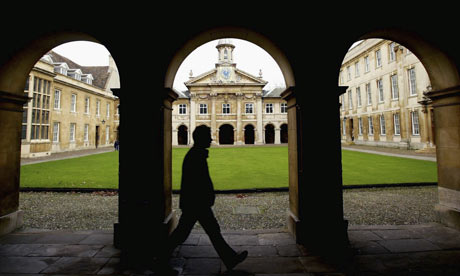
A man at Cambridge University

Top 100 universities: Cambridge came second Photograph: Graeme Robertson/Getty

Oxford University has slipped in the international league table of the world's top universities - in a study which shows the advance of academia in Asia that will soon pose a challenge to the Ivy League and Oxbridge.

The study, from Times Higher Education and QS Top Universities shows that overall the UK still punches above its weight, second only to the US. The UK has four out of the top 10 slots and 18 in the top 100. But there has been a significant fall in the number of North American universities in the top 100, from 42 in 2008 to 36 in 2009.

However, the number of Asian universities in the top 100 increased from 14 to 16. The University of Tokyo, at 22, is the highest ranked Asian university, ahead of the University of Hong Kong at 24.


The world's top universities

2009 Rank
2008 Rank
School Name
Country
11HARVARD UniversityUnited States
23University of CAMBRIDGEUnited Kingdom
32YALE UniversityUnited States
47UCL (University College London)United Kingdom
56IMPERIAL College LondonUnited Kingdom
54University of OXFORDUnited Kingdom
78University of CHICAGOUnited States
812PRINCETON UniversityUnited States
99MASSACHUSETTS Institute of Technology (MIT)United States
105CALIFORNIA Institute of Technology (Caltech)United States
1110COLUMBIA UniversityUnited States
1211University of PENNSYLVANIAUnited States
1313JOHNS HOPKINS UniversityUnited States
1413DUKE UniversityUnited States
1515CORNELL UniversityUnited States
1617STANFORD UniversityUnited States
1716AUSTRALIAN National UniversityAustralia
1820MCGILL UniversityCanada
1918University of MICHIGANUnited States
2024ETH Zurich (Swiss Federal Institute of Technology)Switzerland
2023University of EDINBURGHUnited Kingdom
2219University of TOKYOJapan
2322KING'S College LondonUnited Kingdom
2426University of HONGKONGHong Kong
2525KYOTO UniversityJapan
2629University of MANCHESTERUnited Kingdom
2721CARNEGIE MELLON UniversityUnited States
2828École normale supérieure, PARISFrance
2941University of TORONTOCanada
3030National University of Singapore (NUS)Singapore
3127BROWN UniversityUnited States
3233NORTHWESTERN UniversityUnited States
3230University of CALIFORNIA, Los Angeles (UCLA)United States
3432University of BRISTOLUnited Kingdom
3539HONG KONG University of Science and TechnologyHong Kong
3634ÉCOLE POLYTECHNIQUEFrance
3638University of MELBOURNEAustralia
3637University of SYDNEYAustralia
3936University of California, BERKELEYUnited States
4034University of BRITISH COLUMBIACanada
4143University of QUEENSLANDAustralia
4250École Polytechnique Fédérale de LAUSANNESwitzerland
4344OSAKA UniversityJapan
4349TRINITY College DublinIreland
4547MONASH UniversityAustralia
4642The CHINESE University of Hong KongHong Kong
4750SEOUL National UniversityKorea, South
4745University of NEWSOUTH WALESAustralia
4956TSINGHUA UniversityChina
4953University of AMSTERDAMNetherlands
5148University of COPENHAGENDenmark
5240NEW YORK University(NYU)United States
5250PEKING UniversityChina
5446BOSTON UniversityUnited States
5578Technische Universitaet Muenchen (TUM)Germany
5561TOKYO Institute of TechnologyJapan
5757HEIDELBERG UniversityGermany
5869University of WARWICKUnited Kingdom
5974University of ALBERTACanada
6064LEIDEN UniversityNetherlands
6165The University of AUCKLANDNew Zealand
6155University of WISCONSIN-MadisonUnited States
6381AARHUS UniversityDenmark
6371University of ILLINOIS, Chicago (UIC)United States
6572Katholieke Universiteit LEUVENBelgium
6675University of BIRMINGHAMUnited Kingdom
6766LONDON School of Economics and Political ScienceUnited Kingdom
6788LUND UniversitySweden
6995KAIST – Korea Advanced Institute of ScienceKorea, South
7081University of YORKUnited Kingdom
7067UTRECHT UniversityNetherlands
7268University of GENEVASwitzerland
7377Nanyang Technological University (NTU)Singapore
7360WASHINGTON University in St. LouisUnited States
7563UPPSALA UniversitySweden
7658University of CALIFORNIA, San DiegoUnited States
7670University of TEXAS at AustinUnited States
78102University of NORTH CAROLINA, Chapel HillUnited States
7973University of GLASGOWUnited Kingdom
8059University of WASHINGTONUnited States
81106University of ADELAIDEAustralia
8276University of SHEFFIELDUnited Kingdom
8378DELFT University of TechnologyNetherlands
8483University of WESTERN AUSTRALIAAustralia
8554DARTMOUTH CollegeUnited States
8683GEORGIA Institute of TechnologyUnited States
8799PURDUE UniversityUnited States
8783University of STANDREWSUnited Kingdom
89108University College DUBLINIreland
9062EMORY UniversityUnited States
9186University of NOTTINGHAMUnited Kingdom
92120NAGOYA UniversityJapan
92106University of ZURICHSwitzerland
94137Freie Universität BERLINGermany
95124National TAIWAN UniversityTaiwan
9599University of SOUTHAMPTONUnited Kingdom
97112TOHOKU UniversityJapan
9893Ludwig-Maximilians-Universität MünchenGermany
99104University of LEEDSUnited Kingdom
10078RICE UniversityUnited States