Saturday, August 1, 2009

Enjoy an Ayurveda massage

Enjoy an Ayurveda massage
by Kalwant Kour
Sat, Aug 01, 200

DESPITE the concept of ayurveda having been around for thousands of years, the closest I had come to it was something that came out of a bottle.
So when this “ayurveda virgin” ventured into Ayush Ayurveda clinic for some treatment for my long-standing sinus and asthma issues, I was not sure what to expect. But ayurveda physician Bindu Ancy Joshy put me at ease immediately.

She assured me that the only way to get to know ayurveda was to experience it.

Dr Bindu explained that ayurveda treatments are based on three fundamental elements: Vata Dorsha (wind element),

Pitta Dosha (fire element) and Kapha Dosha (water element). And before any hands, or oil for that matter, touch your body, the doctors at the clinic do a full consultation with you to find out more about your body’s constitution.

That way, they can pick the correct course of treatment to enhance your health and emotional well being.

Ayurveda believes in the treatment of not just the affected part but the total well-being of the person.

After the consultation, which took about half an hour, a Kerala-trained therapist was briefed on my body condition and the necessary treatments and oils to be used for the massage. Since I had an asthma condition, a warm oil – imported from Kerala according to Dr Bindu – was used on my head.

But honestly nothing prepared me for the massage part of the treatment when I was handed a loincloth and told to put it on. I was apparently lucky as usually you have to be nude for the massages.

For the first part of the treatment, I sat in a chair as warm oil was poured on the centre of my head for 10 minutes. This was followed by a firm 10-minute head massage which felt great.

Then began the real journey: As I lay on a wooden bed, a variety of oils were generously poured onto my body as the therapist massaged me. She said the combination
of the oil and massage would improve blood circulation and reduce any swelling from water retention. During the hour-long massage, the therapist also pounded my body with
a warm herbal pouch called the Kizhi. Though this sounds painful, it wasn’t... it actually relieved the stiffness in my neck, shoulders and knees.

And, despite my initial discomfort about being in my birthday suit, the therapist’s magic fingers sent me into dreamland as she worked the knots and aches out of my body.
I walked out of Ayush Ayurveda clinic... no, sorry, I floated out, smelling of oil and loving it. And that night I slept like a baby.

This article was first published in tabla!

Discipline, not abuse, say experts

Discipline, not abuse, say experts
Fri, Jul 31, 2009
The Straits Times

By Theresa Tan

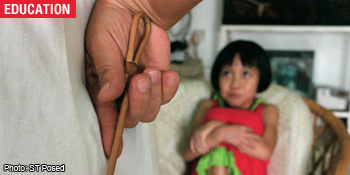
PARENTS who wield the cane ought to ensure that disciplining a child does not cross the line and become abuse, experts said yesterday.

Never lash out at a child in a fit of rage, advised Dr Brian Yeo, a psychiatrist in private practice.

Most parents who do so have lost their sense of reason, he said, and may end up hitting the child harder than they mean to.

Such situations might also have an unintended effect. Dr Yeo said: 'If you hit your child in a fit of anger, you are teaching him that violence is acceptable.'

His advice: If you must use the cane, calm down first and explain your actions before carrying out the punishment.

When does caning turn into abuse?

Dr Yeo said it is generally accepted that abuse occurs if the child's skin is broken or bleeds during caning.

Some parts of the body, such as the face and private parts, are also considered no-go zones, he added.

Caning a child too often can also be considered abuse, he and other counsellors noted.

Abuse from caning is not limited to physical injury only, social workers said.

Children who suffer emotional and psychological trauma as a result of caning are also victims of abuse, they said.

Some become withdrawn, troubled or fearful as a result of repeated caning, said Mrs Wong Cher Meng, centre director of the Students Care Service Clementi Centre.

Those interviewed also warned that caning may not always be the best form of punishment and can backfire on parents.

Mrs Florence Lim, director of the Covenant Family Service Centre, said: 'After the caning, some children get so angry that they rebel and start thinking how to retaliate against their parents.'

Counsellors said other effective disciplinary methods include withholding incentives from a child who has done wrong and rewarding good behaviour.

Parents who fear they are losing control in disciplining their children can seek help from counsellors in schools, family service centres or children's help agencies such as the Singapore Children's Society.

HELPLINE

If you need help, you can call ComCare Call at 1800-222-0000.

This article was first published in The Straits Times.

Language of love

Language of love
Sat, Aug 01, 2009
The Straits Times

By Janice Tai

Learning to read romantic body language can give you a headstart in figuring out if the opposite sex is really into you.

Ms Elizabetta Franzoso, a trainer with the Singapore Institute of Management Professional Development, and psychologist Daniel Koh from Insights Mind Centre, give the lowdown on those signals.


Eye contact

When interest is aroused, the eyes do much of the signalling. Initially and from a distance, a person may look at you for a slightly longer period than normal, then look away, then look back at you again.

Enactment displays

Romantic language may also include enacting sexually stimulating activities like caressing oneself or stroking one's arms, leg or face. This may mean 'I would like to stroke you like this' or 'I would like you to stroke me like this'.

A woman may bring attention to her lips by eating slowly, licking and pursing her lips into a kiss shape or leaving her mouth slightly open in imitation of sexual readiness.

Objects like cigarettes and wine glasses may also be used in enactment displays by rolling and stroking them.

Preening

What a person may be saying with these actions are: 'I am making myself look good for you'. They include the tossing of hair, brushing the hair with one's hand, running a hand through one's hair, polishing one's spectacles and brushing one's clothes.

Display actions

Certain parts of the body may be exposed or highlighted.

A man may move his legs apart and point his crotch area towards the woman. A woman may emphasise her legs by crossing and uncrossing them or hanging her heels on her toe. A man may squeeze his muscles to give the impression of higher muscle tone. A woman may press her breasts together to make them look firmer and larger.

These actions might have primeval origins, experts said. For a woman, they showcase her health and ability to bear and nurture the man's child. For the man, they show that he is virile, strong and able to protect the woman and their child.

Leaning

Leaning towards another person says 'I would like to be closer to you'. It is also a test to gauge the other person's response to see if the person will lean towards you too or away from you.

Pointing

A person who is interested in you may subtly point at you with a foot, knee, arm or head. It is effectively a signal that says 'I would like to go in this direction'.

This article was first published in Mind Your Body, The Straits Times.

Thursday, July 30, 2009

Let’s go back 25 years

Let’s go back 25 years
31 July, 2009

“Could the PKFZ project become a RM12.5 billion “mother of all scandals” if the three Transport Ministers and four PKA Chairmen – all from MCA – had not been equally incompetent and negligent as the PKA managers from day one?” said Lim Kit Siang.

THE CORRIDORS OF POWER

Raja Petra Kamarudin

To understand the present, one has to go back to the past. And in the case of the PKFZ, it has to be at least 25 years into the past.

25 years ago, MCA, the ‘number two’ partner in Barisan Nasional, was going through a crisis, like what is happening today. Neo Yee Pan, the new President, had taken over the party leadership in March 1983. He, of course, was ‘Team A’. And as soon as he took over, he ousted his opponents from ‘Team B’ led by Tan Koon Swan and his running mate Ling Liong Sik. With a stroke of the pen, so to speak, both Koon Swan and Liong Sik were out in the wilderness.

Prime Minister Dr Mahathir Mohamad, who himself had just taken over the leadership of Umno a couple of years earlier, was not too pleased. He wanted Koon Swan and Liong Sik to head MCA, not the man whom Umno called ‘the pork seller’. Yes, that was what Umno called Yee Pan, the pork seller, maybe because they thought he looked like one.

Plans were hatched to oust Yee Pan. Koon Swan and Liong Sik were told to cool their heels for a year or so while Dr Mahathir figures out his moves. They spent a short stint in Bolton, itching to get back into the political arena and grab back control of MCA.

Just before Dr Mahathir left for his overseas trip, he sent an emissary to meet Yee Pan with the message that he wants him out of MCA. And when he returns from his overseas trip he wants to see Yee Pan’s resignation letter on his table as a sort of ‘insurance policy’. The message was very clear. Go quietly and without any fuss or else get shoved out in a bloody and take-no-prisoners battle.

Yee Pan knew better than to take on Umno and Dr Mahathir. He decided that the best for his continued health would be to put his tail between his legs and exit with his head still attached to his shoulders.

In November 1985, Koon Swan and his running mate Liong Sik took over the leadership of MCA and Dr Mahathir was utmost pleased that at last MCA was being led by the people who he was most comfortable working with. Unknown to the MCA members at large, it was not the Chinese but Umno and the Prime Minister who decided their party’s fate and future.

Then Koon Swan suddenly found himself swamped with loads of legal problems. The 1985 recession had come without warning and to solve his financial predicament Koon Swan had done something illegal and the Singapore government caught him with his pants down. Dr Mahathir had no choice but to allow Singapore to send Koon Swan to jail and, in September 1986, Liong Sik found himself suddenly in charge of MCA as its new President.

Koon Swan was president of MCA for just ten months. He was in jail for longer than that.

A year later, Umno too went into crisis when it too saw the emergence of a Team A and Team B, just like MCA a couple of years before that. This crisis eventually led to the deregistering of the party by the Registrar of Societies and suddenly MCA found itself the lead partner of Barisan Nasional with Liong Sik as its new Chairman.

Umno no longer existed.

Dr Mahathir quickly registered a new party, which he called Umno Baru. But Umno Baru was not a component member of Barisan Nasional. The old Umno was. But the old Umno no longer existed. Umno Baru would need to apply to join Barisan Nasional just like any new party that wanted to join Barisan Nasional would have to do.

But the procedure to join Barisan Nasional is that all component members of Barisan Nasional must unanimously agree to admit this new member. A simple majority would not do. Even one dissenting voice would mean that the application to join Barisan Nasional would be rejected. And it would the Chairman of Barisan Nasional, Liong Sik, who would have to make sure that Umno is admitted into the coalition.

Liong Sik was a very crucial element for Umno. Without the lead partner of Barisan Nasional, now of course MCA, leading the charge, Umno is sunk. Umno would have to remain an independent party and Dr Mahathir would have to resign as Prime Minister as he would no longer command the majority seats in Parliament. Dr Mahathir, for all intents and purposes, was in fact now an independent Member of Parliament and legally no longer Prime Minister of Malaysia.

Yes, Liong Sik saved Umno. And he saved Dr Mahathir as well. Without him Umno and Dr Mahathir would be history while MCA would be the head honcho of Barisan Nasional with Liong Sik as Malaysia’s new Prime Minister. Dr Mahathir himself said that the Federal Constitution of Malaysia does not forbid a Chinese from becoming Prime Minister of Malaysia.

There is a special relationship between Umno and MCA’s past leaders that many Malaysians do not know about. MCA and Liong Sik are what the Malays would call talian hayat or lifeline. It was so more than 20 years ago. It is still so today.

In fact, today, it is even more so. Umno no longer holds more than 50% of the seats in Parliament. Without MCA’s 15 seats and another 30 from Sarawak, Umno is out of business. Sabah has another dozen or so and MIC and Gerakan another five combined. But these are not as crucial as MCA’s 15 and Sarawak’s 30. These 45 seats from MCA and Sarawak are what ensure that Umno remains in power.

The opposition wants to nail the balls of those involved in PKFZ to the wall. That would not be possible. If Umno allows the opposition to bring down all those behind the PKFZ then MCA and Sarawak will fall. And with them Umno too will fall. It is like all of them drifting in the same lifeboat. You can’t allow anyone to sink the lifeboat when you are also in it as that would mean you too would drown. So Umno needs to save MCA and the Sarawak politicians just so that it too will not fall. It is a case of survival and when your survival depends on others you have to make sure that they survive so that you too can survive.

The link between MCA and the PKFZ is clear. That is already public knowledge. The link between the Sarawak politicians and the PKFZ is also very clear because that too is public knowledge. But what many do not know is the link between MCA and the Sarawak politicians.

Many are perplexed as to why Ong Tee Keat (OTK) is trying to protect those behind the PKFZ. After all, those implicated are all ex-leaders of MCA and surely their downfall would not affect MCA. Actually, it is not just about the ex-leaders of MCA. It is also about the Chinese corporate bosses and the Sarawak leaders who have their hands dirty with the PKFZ fiasco.

The link between OTK and the Sarawak leaders may be a well-kept secret. But when OTK flies all over the place with Tiong King Sing’s private jet how can you keep this a secret?

As follows are some of the flight details we managed to get our hands on:

12 Feb G450 SZB/JB/KCH (ETD 11.00/12.00/17.00)
19 Feb G450 SZB/JB/SZB (ETD 7.30/22.30)
7 Mar Learjet 60 SZB/Kuantan/SZB (ETD 12.00/22.00)
24 Mar Learjet 60 SZB/JB/SZB (ETD 15.30/22.00)
20 Apr Learjet 60 SZB/JB/SZB (ETB 17.30/23.00)

“Could the PKFZ project become a RM12.5 billion “mother of all scandals” if the three Transport Ministers and four PKA Chairmen – all from MCA – had not been equally incompetent and negligent as the PKA managers from day one?” said Lim Kit Siang.

Actually, it is not about incompetence at all. Incompetence means they do not know what they are doing -- which would mean they are stupid. These people know what they were doing all along. They were ripping off RM12.5 billion of the rakyat’s money. And Umno just can’t do anything about it. Umno does not want to do anything about it. If they do something about it then MCA and the Sarawak politicians will have to suffer a fall. And 45 Parliament seats that are propping up Umno will also fall. And when 45 Parliament seats fall, then Umno too will fall.

It is all about survival. And Umno’s survival depends on MCA and Sarawak surviving. And would Umno be the head honcho of Barisan Nasional today if not for MCA and Liong Sik? So how can Umno not cover their ass when 20 years or so ago MCA and Liong Sik gave Umno its second lease in life? MCA and Liong Sik made Umno into what it is today. If not there would no longer be any party called Umno.

And this is how Umno says ‘thank you’ to MCA and Liong Sik. It makes sure that the PKFZ issue remains a non-issue. And the rakyat will just have to carry the RM12.5 billion financial losses for the sake of Umno and MCA remaining in power. That is the price the rakyat have to pay so that these people can stay in office.

It is ironical how the Chinese whack the Malays for what Umno is doing to the country. If only the Chinese knew that Umno is still around today because of MCA and Liong Sik. But then these Chinese were never really that smart anyway. If they were smart they would have blocked Umno from getting admitted into Barisan Nasional 21 years ago back in 1988.

Bodoh punya Cina! They deserve Umno and MCA. And they deserve losing RM12.5 billion of their tax money, 90% of which comes from the Chinese anyway. And today Ong Tee Keat is what Ling Liong Sik was 21 years ago, the man who ensures that Umno stays in office. So do you think OTK will allow the PKFZ issue to get out of control? After all, if Tiong goes down then he would not get to fly around in a private jet any longer.

*************************************************

Could the PKFZ project become a RM12.5 billion “mother of all scandals” if the three Transport Ministers and four PKA Chairmen – all from MCA – had not been equally incompetent and negligent as the PKA managers from day one?

Lim Kit Siang

The Public Accounts Committee (PAC) Chairman blamed the RM12.5 billion Port Klang Free Zone (PKFZ) scandal on “a group of incompetent people” from day one. (NST)

The ad hoc committee on corporate governance probing the PKFZ fiasco, headed by Transparency International chairman Datuk Paul Low Seng Kuan, denounced the PKA Board members for “gross negligence” in failing to discharge their fiduciary duties diligently, resulting in the RM12.5 billion PKFZ scandal.

Both Azmi and Low are only half right. Could the PKFZ project become a RM12.5 billion “mother of all scandals” if the three Transport Ministers (Ling Liong Sik, Chan Kong Choy, Ong Tee Keat) and four PKA Chairmen (Ting Chew Peh, Yap Pian Hon, Chor Chee Heung and Lee Hwa Beng) – all from MCA – had not been equally incompetent and negligent as the PKA managers “from day one”?

Yesterday, the second Transport Minister mired in the RM12.5 billion PKFZ scandal, Tan Sri Chan Kong Choy appeared before the PAC in its inquiry into the PKFZ scandal, ensconced by a lawyer and two aides as well as lugging a box of relevant documents, giving the impression as if he is appeared as an accused in a public inquiry.

Chan created PAC history in 52 years in being the first to appear with counsel before a PAC hearing. Why was this necessary and why did the PAC Chairman allow Chan to appear with counsel? This is indeed most extraordinary and even self-incriminating.

Even more extraordinary was that Chan produced an opinion from a Queen’s Counsel in the UK that the three Letters of Support which he had signed in support of PKFZ were not letters of guarantee.

How much did it cost Chan to get the opinion of a Queen’s Counsel for him to go to the PAC with it to back up his argument? Easily over 10,000 sterling pounds i.e. RM60,000 to RM100,000.

Why didn’t Chan get a Queen’s Counsel opinion when he was the Transport Minister in 2007 to convince the Cabinet that his three Letters of Support were not government “Letters of Guarantee” for the RM4 billion bonds raised by the PKFZ turnkey developer, Kuala Dimensi Sdn. Bhd. (KDSB) as Malaysian taxpayers would have been spared being victims of the RM12.5 billion PKFZ scandal?

In 2007, the Cabinet was advised by the Attorney-General and Treasury that the four Letters of Support to KDSB to raise RM4 billion bonds were implicit government guarantees to the bond market.

As a result, the Cabinet gave retrospective approval for the four unlawful and unauthorized Letters of Support, one issued by Tun Dr. Ling Liong Sik in May 2003 and three by Chan, creating the RM4.6 billion liability for the government in the bailout of PKFZ which is now set to become a RM12.5 billion scandal.

What is most shocking is that Chan did not formally table the opinion of the Queen’s Counsel to the PAC but only referred to it orally. This is most improper and irregular and Chan should be recalled to formally table the opinion of the Queen’s Counsel, so that it becomes part of the documentation of the PAC report in its inquiry into the PKFZ when submitted to Parliament.

As reported in the New Straits Times, Azmi said the PAC is expected to table its findings on the PKFZ scandal in the Dewan Rakyat by October when the House resumed its sitting. It will also prepare a report for the Malaysian Anti-Corruption Commission to revisit the project and look into certain areas, which were not touched by the commission in its earlier investigation.

Azmi has got his parliamentary responsibilities as PAC Chairman all wrong. His duty as PAC Chairman is to report to Parliament and not to MACC or even the government. His job is to ensure that the PAC report and recommendations on the PKFZ scandal is first tabled in Parliament and not to submit any report to the MACC or elsewhere.

It is then for Parliament to decide whether to accept the PAC findings and recommendations, including whether the PAC report should be forwarded to MACC for necessary action, or whether to reject the PAC report because it is unsatisfactory and unacceptable.

In the latter circumstances, Parliament should invoke its full powers to hold an inquiry of the full House into the PKFZ scandal, should it arrive at the conclusion that the PAC report falls far short of parliamentary standards and expectations.

In which case, all the witnesses who had appeared before the PAC, including the current and previous Transport Ministers, Tee Keat, Kong Choy and Liong Sik can be recalled.

Azmi should not forget that PAC is delegated by Parliament to inquire into the PKFZ scandal and Parliament must decide whether to accept its findings and recommendations before further follow-up action is taken on the PAC report.

This point must be emphasized especially in a case of such great public interest and controversy like the RM12.5 billion PKFZ scandal.

As Parliament is reconvening on Oct. 19, and two weeks notice is required for a motion to accept or reject the PAC report on the PKFZ inquiry, Azmi should ensure that the PAC report on the PKFZ is circulated to MPs by end of September to allow MPs time to study it and decide whether a special motion on the PAC report on the PKFZ scandal should be moved – although formally, the PAC report would only be tabled in Parliament on Oct. 19 itself.

*************************************************

Tiong dares Lim to repeat claims outside

BACKBENCHERS Club chairman Datuk Seri Tiong King Sing lost his cool with veteran MP Lim Kit Siang over the Port Klang Free Zone (PKFZ) issue, even challenging the DAP adviser to repeat his allegations outside the House “if he dares”.

The Ipoh Timur MP had spoken at length about the issue when Tiong came into the House to interject.

“Repeat it outside the Dewan if you dare,” the Bintulu MP repeatedly challenged Lim.

At one point, Tiong told Lim not to hide under the cloak of Dewan Rakyat immunity. Datuk Bung Moktar Radin (BN – Kinabatangan) and Datuk Ismail Kassim (BN – Arau) also stood to seek clarification several times.

While Lim went on speaking about the issue, Datuk Seri Tengku Adnan Tengku Mansor (BN – Putrajaya) shouted “gila” (mad), Bung Mokhtar uttered that Lim was talking rubbish and Tiong accused Lim of misleading the House before they themselves left the chambers.

Earlier, Lim expressed disappointment with chief commissioner of the Malaysian Anti-Corruption Commission, who turned up at the Public Accounts Committee (PAC) meeting but offered no details of the investigation into PKFZ.

“He is not willing to work with Parliament? Isn’t it not Parliamentary contempt?” he asked.

PAC chairman Datuk Seri Azmi Khalid rebutted the accusation, saying that the committee might call Attorney-General Tan Sri Abdul Gani Patail to attend its meeting.

He also told Lim that two of the Opposition MPs in PAC supported him when he received a letter from Lim urging him (Azmi) to resign as PAC chairman and not lead in the PKFZ probe.

However, Lim insisted that Azmi, who was in Cabinet between 2004 and 2007, should be a witness in the PKFZ probe as he was party to the Cabinet decisions on PKFZ. - The Star

*************************************************

Tiong to file suit against Lee over PKFZ report
By LEE YUK PENG, The Star

KUALA LUMPUR: Wijaya Baru Holdings Sdn Bhd chief executive officer Datuk Seri Tiong King Sing said he will be suing Port Klang Authority (PKA) board chairman Datuk Lee Hwa Beng and several others within a few weeks over the Port Klang Free Zone (PKFZ) audit report.

Nanyang Siang Pau reported on the front page of its evening edition last night that Tiong would also be suing auditing firm PricewaterhouseCoopers (PWC) Advisory Services Sdn Bhd and several media companies.

Tiong told the daily that Kuala Dimensi Sdn Bhd had appointed a team of lawyers to study the audit report to draft the suit. Tiong is a 70% shareholder of Wijaya Baru Holdings, which is the sole proprietor of Kuala Dimensi Sdn Bhd, the turnkey developer of PKFZ.

Speaking after launching a Buddhist project in Petaling Jaya yesterday, Tiong said that he decided to sue Lee and not PKA.

Tiong also challenged Lee to use his money and not PKA funds to defend himself.

Tiong, who is also Bintulu MP and Backbenchers Council chairman, warned Lim Kit Siang (DAP - Ipoh Timur) that he may be sued too.

Kuala Dimensi also took up full page advertorials in Sin Chew Daily, Nanyang, China Press and Guang Ming Daily to explain its position.

It said the PWC’s report, which was incomplete, had tarnished the company’s reputation.

When contacted, Lee said: “I have to wait for the suit and will inform my lawyers to file a defence. Whatever I did is on behalf of PKA and for the good of taxpayers.”


Do you remember Animal Farm?

Do you remember Animal Farm?
31 July, 2009

In 1946, the Malays united and formed a national organisation called UMNO. In 1951, the Malays, Chinese and Indians united to form The Alliance. In 1957, a union of Malays, Chinese and Indians won Merdeka for Malaya and the British colonialists were sent packing. Thereafter, the Malayan political scene transformed into a real-life situation of Animal Farm.

NO HOLDS BARRED

Raja Petra Kamarudin

At last the day came when Snowball's plans were completed. At the Meeting on the following Sunday the question of whether or not to begin work on the windmill was to be put to the vote. When the animals had assembled in the big barn, Snowball stood up and, though occasionally interrupted by bleating from the sheep, set forth his reasons for advocating the building of the windmill.

Then Napoleon stood up to reply. He said very quietly that the windmill was nonsense and that he advised nobody to vote for it, and promptly sat down again; he had spoken for barely thirty seconds, and seemed almost indifferent as to the effect he produced. At this Snowball sprang to his feet, and shouting down the sheep, who had begun bleating again, broke into a passionate appeal in favour of the windmill.

Until now the animals had been about equally divided in their sympathies, but in a moment Snowball's eloquence had carried them away. In glowing sentences he painted a picture of Animal Farm as it might be when sordid labour was lifted from the animals' backs. His imagination had now run far beyond chaff-cutters and turnip-slicers. Electricity, he said, could operate threshing machines, ploughs, harrows, rollers, and reapers and binders, besides supplying every stall with its own electric light, hot and cold water, and an electric heater.

By the time he had finished speaking, there was no doubt as to which way the vote would go. But just at this moment Napoleon stood up and, casting a peculiar sidelong look at Snowball, uttered a high-pitched whimper of a kind no one had ever heard him utter before.

At this there was a terrible baying sound outside, and nine enormous dogs wearing brass-studded collars came bounding into the barn. They dashed straight for Snowball, who only sprang from his place just in time to escape their snapping jaws. In a moment he was out of the door and they were after him. Too amazed and frightened to speak, all the animals crowded through the door to watch the chase. Snowball was racing across the long pasture that led to the road.

He was running as only a pig can run, but the dogs were close on his heels. Suddenly he slipped and it seemed certain that they had him. Then he was up again, running faster than ever, then the dogs were gaining on him again. One of them all but closed his jaws on Snowball's tail, but Snowball whisked it free just in time. Then he put on an extra spurt and, with a few inches to spare, slipped through a hole in the hedge and was seen no more.

Silent and terrified, the animals crept back into the barn. In a moment the dogs came bounding back. At first no one had been able to imagine where these creatures came from, but the problem was soon solved: they were the puppies whom Napoleon had taken away from their mothers and reared privately. Though not yet full-grown, they were huge dogs, and as fierce-looking as wolves. They kept close to Napoleon. It was noticed that they wagged their tails to him in the same way as the other dogs had been used to do to Mr. Jones.

Napoleon, with the dogs following him, now mounted on to the raised portion of the floor where Major had previously stood to deliver his speech. He announced that from now on the Sunday-morning Meetings would come to an end. They were unnecessary, he said, and wasted time. In future all questions relating to the working of the farm would be settled by a special committee of pigs, presided over by himself. These would meet in private and afterwards communicate their decisions to the others. The animals would still assemble on Sunday mornings to salute the flag, sing 'Beasts of England', and receive their orders for the week; but there would be no more debates.

In spite of the shock that Snowball's expulsion had given them, the animals were dismayed by this announcement. Several of them would have protested if they could have found the right arguments. Even Boxer was vaguely troubled. He set his ears back, shook his forelock several times, and tried hard to marshal his thoughts; but in the end he could not think of anything to say.

Some of the pigs themselves, however, were more articulate. Four young porkers in the front row uttered shrill squeals of disapproval, and all four of them sprang to their feet and began speaking at once. But suddenly the dogs sitting round Napoleon let out deep, menacing growls, and the pigs fell silent and sat down again. Then the sheep broke out into a tremendous bleating of "Four legs good, two legs bad!" which went on for nearly a quarter of an hour and put an end to any chance of discussion.

Afterwards Squealer was sent round the farm to explain the new arrangement to the others.

"Comrades," he said, "I trust that every animal here appreciates the sacrifice that Comrade Napoleon has made in taking this extra labour upon himself. Do not imagine, comrades, that leadership is a pleasure! On the contrary, it is a deep and heavy responsibility. No one believes more firmly than Comrade Napoleon that all animals are equal. He would be only too happy to let you make your decisions for yourselves. But sometimes you might make the wrong decisions, comrades, and then where should we be? Suppose you had decided to follow Snowball, with his moonshine of windmills--Snowball, who, as we now know, was no better than a criminal?"

"He fought bravely at the Battle of the Cowshed," said somebody.

"Bravery is not enough," said Squealer. "Loyalty and obedience are more important. And as to the Battle of the Cowshed, I believe the time will come when we shall find that Snowball's part in it was much exaggerated. Discipline, comrades, iron discipline! That is the watchword for today. One false step, and our enemies would be upon us. Surely, comrades, you do not want Jones back?"

Once again this argument was unanswerable. Certainly the animals did not want Jones back; if the holding of debates on Sunday mornings was liable to bring him back, then the debates must stop. Boxer, who had now had time to think things over, voiced the general feeling by saying: "If Comrade Napoleon says it, it must be right." And from then on he adopted the maxim, "Napoleon is always right," in addition to his private motto of "I will work harder."

By this time the weather had broken and the spring ploughing had begun. The shed where Snowball had drawn his plans of the windmill had been shut up and it was assumed that the plans had been rubbed off the floor. Every Sunday morning at ten o'clock the animals assembled in the big barn to receive their orders for the week. The skull of old Major, now clean of flesh, had been disinterred from the orchard and set up on a stump at the foot of the flagstaff, beside the gun. After the hoisting of the flag, the animals were required to file past the skull in a reverent manner before entering the barn.

Nowadays they did not sit all together as they had done in the past. Napoleon, with Squealer and another pig named Minimus, who had a remarkable gift for composing songs and poems, sat on the front of the raised platform, with the nine young dogs forming a semicircle round them, and the other pigs sitting behind. The rest of the animals sat facing them in the main body of the barn. Napoleon read out the orders for the week in a gruff soldierly style, and after a single singing of 'Beasts of England', all the animals dispersed.

On the third Sunday after Snowball's expulsion, the animals were somewhat surprised to hear Napoleon announce that the windmill was to be built after all. He did not give any reason for having changed his mind, but merely warned the animals that this extra task would mean very hard work, it might even be necessary to reduce their rations. The plans, however, had all been prepared, down to the last detail. A special committee of pigs had been at work upon them for the past three weeks. The building of the windmill, with various other improvements, was expected to take two years.

That evening Squealer explained privately to the other animals that Napoleon had never in reality been opposed to the windmill. On the contrary, it was he who had advocated it in the beginning, and the plan which Snowball had drawn on the floor of the incubator shed had actually been stolen from among Napoleon's papers. The windmill was, in fact, Napoleon's own creation.

Why, then, asked somebody, had he spoken so strongly against it? Here Squealer looked very sly. That, he said, was Comrade Napoleon's cunning. He had SEEMED to oppose the windmill, simply as a manoeuvre to get rid of Snowball, who was a dangerous character and a bad influence. Now that Snowball was out of the way, the plan could go forward without his interference. This, said Squealer, was something called tactics. He repeated a number of times, "Tactics, comrades, tactics!" skipping round and whisking his tail with a merry laugh. The animals were not certain what the word meant, but Squealer spoke so persuasively, and the three dogs who happened to be with him growled so threateningly, that they accepted his explanation without further questions.

All that year the animals worked like slaves. But they were happy in their work; they grudged no effort or sacrifice, well aware that everything that they did was for the benefit of themselves and those of their kind who would come after them, and not for a pack of idle, thieving human beings.

Throughout the spring and summer they worked a sixty-hour week, and in August Napoleon announced that there would be work on Sunday afternoons as well. This work was strictly voluntary, but any animal who absented himself from it would have his rations reduced by half. Even so, it was found necessary to leave certain tasks undone. The harvest was a little less successful than in the previous year, and two fields which should have been sown with roots in the early summer were not sown because the ploughing had not been completed early enough. It was possible to foresee that the coming winter would be a hard one.

Animal Farm by George Orwell (extracts from chapters 5 and 6)

'Criminals here seem to have gone crazy'

'Criminals here seem to have gone crazy'
Fri, Jul 31, 2009
The New Paper

By Gan Ling Kai

JUST three weeks ago, his car became a target of crime in Johor Baru.

The thief smashed its window, and stole a cash card machine and the cash card.

It was the second time in a few years that actor Yao Wenlong's car window had been smashed.

Although not much was stolen in both instances - the cash card had only RM50 ($20) in the latest incident - the incidents rattled the Singapore PR's confidence.

'It's better to park your car in a crowded place, and you should not leave any valuables in it,' he said.

If a recent online poll by the Malaysian Home Ministry is any indication, most people feel unsafe in Malaysia.

According to the poll, 97 per cent of 9,776 respondents as of 5pm yesterday said they did not feel safe, because of the high crime rate.

More than 60 per cent said this was because they or their family members were crime victims. Only 1 per cent said they felt safe.

However, like most online polls, anyone could vote, and vote any number of times.

Wenlong's actor friend Chen Hanwei, 39, another Singaporean PR, crosses the Causeway twice a month to spend time with his parents.

Hanwei says he exercises extra caution on these visits.

His parents live in an estate of more than 100 houses. The estate has 3m-high wire fence all round it, and is guarded by more than 10 security personnel round the clock on foot or bicycles.

'I hardly leave my doorstep the moment I'm home. Even if I have to travel, I make sure I park my car at a spot where I can see it,' he said.

The New Paper also spoke to Mr Haji Mohd Sulaiman, 60, village chief of Kampung Parit Raja in Batu Pahat, Johor.

The retired teacher claimed that despite frequent police patrols in his village, crime still occurs.

'There are about 16 policemen on their rounds regularly. The villagers also patrol the area, but they are unarmed,' he said.

Still, two weeks ago, his two motorcycles were stolen. He claimed that the theft happened around 3am, when he was asleep.

Alarm system

Another Johor resident, Mr Jackie Long, 46, who owns an automobile accessories shop, said an alarm system for a car is not enough to fend off burglars.

Increasingly, Malaysian car owners are purchasing 'immobilisers', he said.

Priced at RM600 ($250) each, these immobilisers prevent the engine from running unless the correct key is used.

This prevents the car from being 'hot wired', which means starting it without a key.

Is the situation better in Kuala Lumpur?

No, says KL resident Hazarina Zakaria, 31, a business development manager.

Her ex-colleague was walking towards her car, parked outside her office building, when someone snatched her bag, said Ms Hazarina.

The victim tried to put up a fight but fell to the ground, suffering abrasions. She had to take long leave from work to recover from the trauma.

'I never thought that such violence could happen to my friend. The criminals here seem to have gone crazy. I myself feel like a 'psycho' when I have to keep looking over my shoulder. These days, you can get robbed even in crowded places,' she said.

The window of her own car was recently smashed by a thief, she added. A laptop case was stolen. Fortunately, the case was empty.

The car of another KL resident - Ms Milly Ngoh - was stolen about six years ago.

Ms Ngoh said: 'My husband had parked it by the side of the road and gone to relieve himself by the corner but when he returned, the car was gone. The thief was really fast.'

Fashion designer David Fung, 39, whose workshop is in KL, said one of his staff, too, was a victim of a snatch theft.

'She was riding behind her husband on a motorbike when another motorcyclist reached out to grab her anklet,' he said.

Doesn't use same route

To be safe, Mr Fung himself doesn't use the same route to go home every day.

Miss Falisa Abu Bakar, 40, who lives in a KL condominium, has not been attacked, but she is also on guard all the time.

'Gone are the days when we could feel safe walking to the shops. Last time, when we dine out, we could just plonk our bag on the empty seat next to us. Now, we have to hold on to our belongings.'

Miss Falisa said the crime situation in KL is probably related to the 'Mat Rempit' gangs - bikers illegally racing and performing stunts on public roads.

They are known to also commit snatch theft and armed robbery.

But not everyone agrees Malaysia is unsafe.

Former Malaysian crime reporter Ahmad Asri Khalbi told The New Paper he feels secure in his country.

'I can drink teh tarik in Johor alone at midnight and still feel safe,' said Mr Ahmad Asri, 38.

He added: 'I don't bother to install any alarm system. When I am away, my neighbour watches over my house.'

Prime Minister Najib Razak has declared war on crime, pledging to bring down the crime rate on the streets by 20 per cent next year.

'Four main areas - Kuala Lumpur, Selangor, Penang, and Johor - have been identified as the hot spots for this type of (street) crime,' he said in Kuala Lumpur on Monday , while setting his administration's targets.

- Nurul Asyikin Mohd Nasir and Ervina Mohamed Jamil, newsroom interns

This article was first published in The New Paper.

Tuesday, July 28, 2009

Overseas students don't want to work in Singapore

Overseas students don't want to work in Singapore
Tue, Jul 28, 2009
AsiaOne

Jonah , 22, has been studying in US for less than a year, but he has already decided that he will not return to Singapore to work after graduation.

A first-year student taking computer science at Stanford University, he says that US is far ahead of Singapore in science and technology. Situated near the Silicon Valley, Stanford's outstanding students are offered jobs by top IT firms even before they graduate.

"They have the world's top firms like Google, Microsoft and Apple - companies that value creativity. Working for them will broaden my horizons and improve my resume," he told my paper.

"While there are also many multi-national companies in Singapore, my impression is that they focus on product assembly, marketing and sales."

According to a survey by Experiences 2009, the organiser of an annual US education convention, there are quite a lot of overseas students who think like Jonah.

According to the survey of 153 Singaporean undergraduates at 15 top US universities, as many as 79 per cent prefer to work in US after they graduate. Only 18.1 per cent want to return to Singapore immediately after they complete their studies.

At Chung Cheng High School's 70th anniversary celebration last month, Senior Minister Goh Chok Tong expressed his concerns about this phenomenon. He said that more than one-fifth of the students who performed well between 1996 to 1999 (those who scored at least four 'A's and a B3 in General Paper) are no longer working in Singapore a decade later.

More than one third of those who studied overseas and did not receive scholarships are also not working in Singapore.

In SM Goh's speech he pointed out Singapore's conundrum - while preparing our students to be 'entrepreneurial and world-ready', we are also 'growing wings' on them and more students will be heading overseas to develop their careers in future.

Why they leave

Why has Singapore no hold for these students? Do they leave because the pull factors from other countries are much stronger?

Students interviewed by my paper say that they leave not only because of the lack of job opportunities, but also because Singapore is too stressful, or because they don't feel appreciated.

Ng Hui Jin, 20, a Biology student at Imperial College in UK said that the pace of life is so fast in Singapore she can barely catch her breath at times. She feels that Europeans place more emphasis on quality of life. The pace is slower there and her classmates do not compare their results.

"Perhaps the learning environment and lifestyle here is what keeps Singaporean students in Europe," said Hui Jin.

Ridy Lie, 28, who graduated from Carnegie Mellon in 2003 has worked at Amazon.com for six years. He said that he likes the free and easy culture in American IT companies. A software developer, he can wear t-shirt and jeans to work, and their supervisors do not require that they report to work by a certain time.

"The company also provides a two-storey recreation area which includes a basketball court, arcade and gym. Our bosses even encourage us to spend our time there during work hours, to get inspiration."

Higher pay also played a part in his decision to stay in the US.

"Big IT firms in US will pay a fresh grad between US$60,000 to US$80,000 (S$87,000 to S$115,000) while investment banks and consultancies can pay up to US$90,000 (S$130,000), this is practically three to five times more than what they can get in Singapore."

At least one student says that she wants to leave because she doesn't feel appreciated.

After the financial crisis last year, many firms around the world retrenched a large number of employees and quite a number of graduates made their way back home but were unable to find a job in Singapore.

London School of Economics graduate Ruchika Tulskyan, 22, applied to 20 companies for a job but received no response.

"The government has been encouraging overseas students to return to Singapore, but Singaporean corporations do not seem to hold the same attitude. It has made me doubt my decision to come back."

Disappointed, Ruchika has decided to further her studies at Columbia University next month.

Malaysians’ sweet tooth now at alarming level

Published: Tuesday July 28, 2009 MYT 5:09:00 PM

Malaysians’ sweet tooth now at alarming level

By WINNIE YEOH

GEORGE TOWN: The consumption of sugar by Malaysians has increased by an alarming rate, from an average of 17 teaspoons per person in the 1970s to 26 teaspoons in the new millennium.

Consumers Association of Penang (CAP) president S.M. Mohamed Idris said the consumption might have increased even further now given that the latest research was done in 2005.

He said Malaysians consumed sugar in the form of soft drinks, condensed milk, flavoured drinks, junk food and even breakfast cereals, with a CAP survey revealing that some drinks and food contained 10 teaspoons of sugar in one serving.

Idris said a brand of orange juice contained 40.8 teaspoons of sugar in a two-litre pack while a brand of cordial syrup had 200 teaspoons in a two-litre bottle.

He said that former Domestic Trade and Consumer Affairs Minister Datuk Shahrir Abdul Samad had revealed earlier this year that Malaysia was the eighth highest sugar user in the world.

He said the International Diabetes Institute recorded Malaysia as having the fourth highest number of diabetics in Asia with 800,000 cases in 2007, expected to increase to 1.3 million in 2010.

“Sugar is a widely eaten nutrient-free food and it’s linked to over 60 ailments such as cancer, diabetes, obesity, heart problems, osteoperosis, kidney problems, asthma and allergies.

“According to Health Ministry statistics, 11.6 million of the 16 million adults nationwide are sick with a non-communicable disease like diabetes, hypertension or cancer.

“Malaysia has the most overweight and obese people in Asia with 54% of the adult population either being obese or overweight,” Idris told a press conference at CAP office here Tuesday.

He said that according to World Health Organisation journals, sugar was unnecessary for a person’s diet.

“Thus, CAP calls on the Government to work with food manufacturers to avoid sugar in their products,” he added.

He also urged the Government to make it a requirement for manufacturers to graphically display -- for example, with the number of teaspoons -- the sugar content in their products as well as use a colour-coded system to indicate the sugar level (red for high, orange for medium and green for low).

He said the color-coded system would allow consumers -- even children or those with limited nutritional knowledge or numerical skills -- to easily comprehend risk.

“They should also stop advertisements of highly-sugared drinks and food during children’s TV viewing hours.

“At the same time, the Government should educate schoolchildren and the general public on the dangers of excessive sugar intake through health education and the media, respectively,” he said.

He also said vending machines dispensing junk food and sugary drinks should be removed and replaced with drinking water dispensers at places such as hospitals, airports and schools.